Choosing the right bath means balancing style and budget. Get it wrong and it dominates your bathroom for the wrong reasons. Get it right and it becomes the centrepiece your space deserves. This guide covers the main bath styles, materials and what to consider before you commit.
https://gkplumbing.net/wp-content/uploads/2024/09/Guide-to-the-Different-types-of-bath-1.png22686803Kelly KnellKelly Knell2024-09-12 09:33:302026-06-29 12:34:59A Guide to the Different Types of Bath
A regular boiler system typically includes both a hot water tank and a cold water tank. The hot one stores heated water, whereas the cold version supplies water to the system and maintains pressure.
But sometimes, our heating shuts down and we’re left in the cold. To reduce unnecessary emergency repairs and costs, learn when to replace a hot water tank below.
https://gkplumbing.net/wp-content/uploads/2024/07/When-to-Replace-Your-Hot-Water-Tank-GK-Plumbing-Heating.png22686803GK Plumbing & HeatingGK Plumbing & Heating2024-07-25 14:08:382025-05-06 11:15:48When to Replace Your Hot Water Tank
Regardless of whether you own your property or not, it is important to recognise the signs of a plumbing emergency versus a regular service. Identifying these plumbing problems and solutions could not only stop an emergency from happening, but save your building from damage.
https://gkplumbing.net/wp-content/uploads/2024/03/What-to-Do-in-a-Plumbing-Emergency-GK-Plumbing-Heating-1-2.png22686803GK Plumbing & HeatingGK Plumbing & Heating2024-03-11 12:01:182024-09-06 09:43:59What to Do in a Plumbing Emergency
Whether you’re old boiler is beginning to wane or becomes more expensive to run, you may think about investing in a high-performing, more environmental upgrade. There are regulations in place that restrict the placement of your boiler, so it’s important to consider where your new heating system will go. Two of the most common places in the home are the kitchen and airing cupboards, but each home has different requirements.
At GK Plumbing, we have decades of experience in boiler installations. Within this guide, we’ll cover what the boiler placement regulations are and where your boiler is best suited in your home.
https://gkplumbing.net/wp-content/uploads/2024/02/Where-should-i-put-my-boiler-gk-plumbing-and-heating.png22686803GK Plumbing & HeatingGK Plumbing & Heating2024-02-14 16:20:372025-11-13 12:41:17Boiler Placement Regulations: Where Should I Put My Boiler?
The colder months are upon us and our heating costs are starting to soar. Are you in search of ways to save money on heating? The answer isn’t to freeze, and we urge you to think about what other things can be cut before heating costs.
Afterall, you shouldn’t have to spend your weekends frostbitten, risking your health for a few extra pennies you may not need. Before we get to the heat-saving tips, we need to ask one fundamental question first…
https://gkplumbing.net/wp-content/uploads/2023/10/Cheaper-to-keep-heating-on-all-day.png22686803GK Plumbing & HeatingGK Plumbing & Heating2023-10-23 15:37:092024-09-06 10:20:29Is It Cheaper to Keep Heating on All Day?
If you’re wondering, ‘what does a smart meter do?’, our simple answer is it measures your energy usage which helps provide accurate gas and electricity bills.
With the popularity of these handy little devices growing in recent years, you may be asking, ‘why do I need a smart meter?’ and why they’re now commonplace in most modern homes.
https://gkplumbing.net/wp-content/uploads/2022/05/Signs-your-boiler-needs-replacing-26.png10481573GK Plumbing & HeatingGK Plumbing & Heating2022-05-09 16:30:112024-06-10 15:24:43What Are the Benefits of Smart Meters?
Choosing between an electric boiler and electric radiators isn’t straightforward. Both promise low-carbon heating, but they work differently, cost different amounts to run, and suit different properties. Keep reading for comparisons of how each system works, its efficiency, running costs and size. You can decide which is right for your home.
An electric boiler heats water using electricity instead of gas or oil, so it produces no harmful emissions on site. Like gas boilers, electric models come as:
Combi boilers (combination)
Heat-only boilers (regular)
Smart boilers
System boilers
Their efficiency makes them a popular choice for small households and commercial properties.
What Is an Electric Radiator?
An electric radiator warms a room without relying on plumbing or pipework. It works independently of your central heating system, and its near-100% efficiency makes it a sustainable option for any property type.
How Does an Electric Boiler Work?
An electric boiler connects to the mains electricity supply, much like a kettle. Electricity heats an element, and cold mains water passes over that element to be heated. This heated water is then supplied to your taps and radiators.
How Does an Electric Radiator Work?
An electric radiator also connects to the mains power supply, but it converts electricity into heat directly. Inside, a thermodynamic fluid expands and heats up as electricity passes through it. As the fluid expands, it releases heat into the room.
Which Is More Efficient: Electric Boilers or Electric Radiators?
Both electric boiler and radiator systems are considerably more efficient than a standard gas boiler, which rarely exceeds 90% efficiency.
Electric boilers achieve a 99-100% efficiency rating, though they often carry an ErP rating of D.
Electric radiators are typically 100% efficient, converting all their energy into heat and pairing well with solar panels and renewable batteries. Running costs can be roughly half those of hydronic radiators in some cases.
Neither system burns fuel, so both produce no carbon emissions and can help lower your energy bills.
How Much Do Electric Boilers and Radiators Cost?
Electricity typically costs more per kWh than gas (around 31p vs 5p), though some tariffs charge less overnight. Even so, electric systems can still work out cost-efficient depending on usage.
Electric boiler price
Buying and installing a new unit: £900 to £4,500, depending on type and size
Typical annual running cost: up to £1,568, depending on property size and usage
As an example, a 12 kW boiler running 6 hours a day at 22p per kWh works out at:
Annual: up to £1,584
Monthly: up to £132
Daily: up to £4.40
Hourly: up to 18.3p
Electric radiator cost
Buying a single unit: £25 to £950, with smaller plug-in models cheapest to buy and run
A 3-bedroom home with 12-14 radiators: roughly £300 to £13,300 in total, plus up to £500 for installation
As an example, a 2,000W heater running 6 hours a day at 22p per kWh works out at:
Annual: £2,640
Monthly: £220
Daily: £7
Hourly: 30p
What Size Electric Boiler or Radiator Do I Need?
Electric boiler size
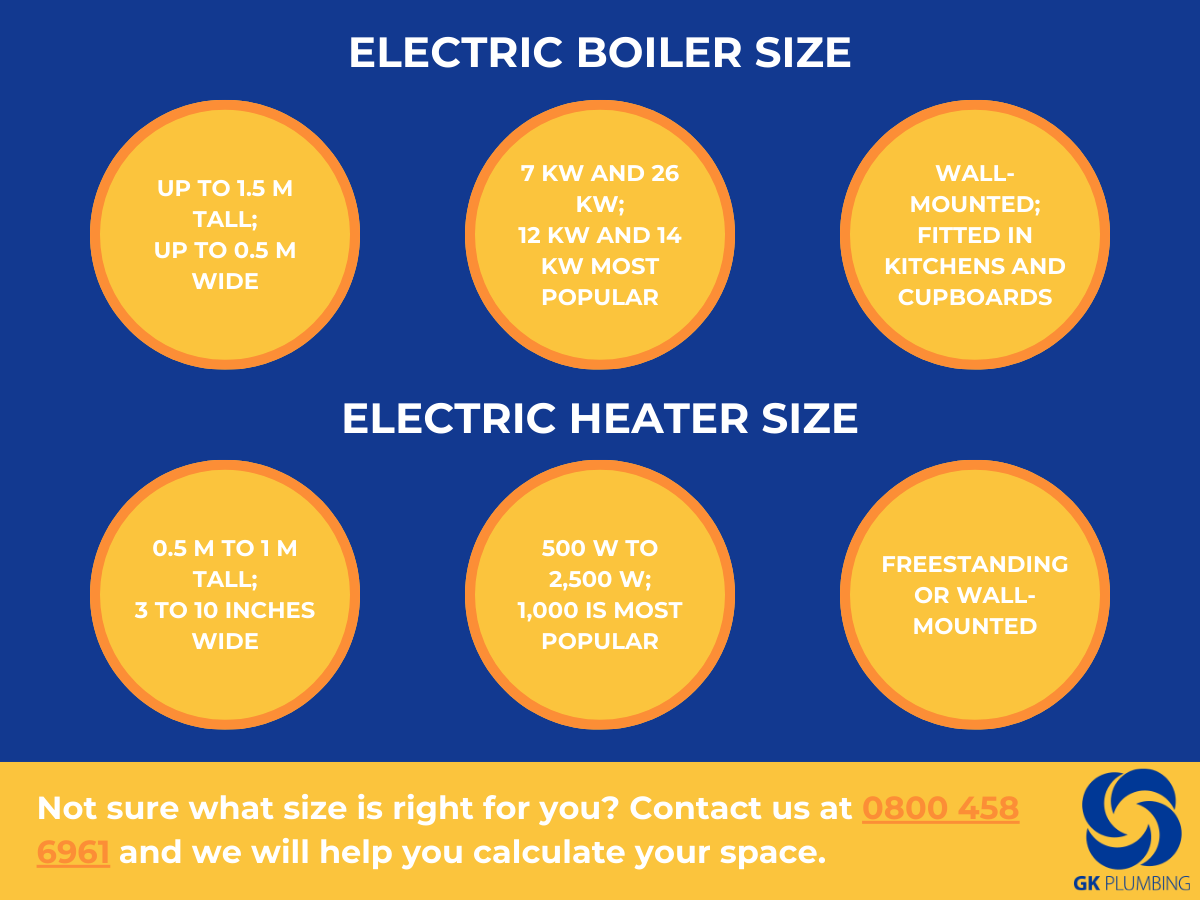
Electric boilers are larger than radiators, typically no more than 1.5m tall and 0.5m wide. Their output usually ranges from 7kW to 26kW, with 12kW and 14kW the most common. Most are wall-mounted in a kitchen or tucked into a storage cupboard.
Electric radiator size
Electric radiators are considerably smaller, usually 0.5m to 1m tall. Wattage typically ranges from 500W to 2,500W, with 1,000W the most common. They’re either freestanding (popular in communal areas) or wall-mounted (suits bathrooms and kitchens).
The Benefits of Each Electric System: Boiler vs Radiator
Electric boilers
Achieve 99-100% efficiency
Suit small spaces, such as flats
Low-maintenance, with no gas leaks, carbon monoxide or explosion risk
Compatible with underfloor heating and radiators
Offer precise electronic controls and smart home integration
Electric radiators
Convert almost all electricity into heat, with minimal waste
No pipework needed, so installation is simple and non-disruptive
No moving parts or combustion, meaning little maintenance
No risk of carbon monoxide leaks or explosions
Available in small, portable options to suit any space
Electric Boiler vs Electric Radiator: Which Should I Choose?
There’s no single right answer, as the best choice depends on your property and budget. Both systems are highly efficient and considerably kinder to the environment than gas alternatives. Over time, an electric boiler is likely to work out cheaper than running multiple electric radiators. It also comes with a broader range of benefits.
https://gkplumbing.net/wp-content/uploads/2022/04/Signs-your-boiler-needs-replacing-28.png10481573GK Plumbing & HeatingGK Plumbing & Heating2022-04-25 10:42:292026-08-10 10:22:48Electric Boiler vs Electric Radiators: Which Is Better?
The electric boiler system has grown in popularity in recent years. With a greater focus on reducing our carbon footprint, its growth shows no signs of slowing down.
However, many people still use gas boilers, which are the cheapest boilers on the market and the easiest to maintain. With this in mind, we have to wonder why so many people are making the switch from a gas to an electric boiler system.
In this article, we will provide an insight into the electric boiler system’s many benefits, including helping the environment.
https://gkplumbing.net/wp-content/uploads/2022/03/Signs-your-boiler-needs-replacing-33.png10481573GK Plumbing & HeatingGK Plumbing & Heating2022-03-09 09:19:112025-05-06 12:01:25Should I Switch to an Electric Boiler System?
Replacing a boiler is a big decision for any homeowner or property manager. With so many boiler brands available on the market, it can be challenging to determine which one is the best fit for your home or business. In this guide, we’ll compare the best boiler brands, such as Baxi, Ideal, Worcester Bosch, Vaillant and Viessman to help you identify what the best boiler is for your property.
https://gkplumbing.net/wp-content/uploads/2021/11/Signs-your-boiler-needs-replacing-48.png10481573GK Plumbing & HeatingGK Plumbing & Heating2021-11-02 14:20:522025-08-27 10:14:17What Are the Best Boiler Brands?
When is it a good time for a boiler upgrade? Obviously, if your current boiler is broken, then it needs replacing. However, that is not to say you should wait for your boiler to break down before you replace it. If you are looking for better efficiency, then you should buy a new boiler. But do you really need a boiler upgrade? Read more
https://gkplumbing.net/wp-content/uploads/2020/08/Signs-your-boiler-needs-replacing-44.png10481573GK Plumbing & HeatingGK Plumbing & Heating2020-08-19 15:25:092024-03-20 10:53:06Is It Time for a Boiler Upgrade?